

Discover
Why now: Syria is getting ready
Compliance has become a national priority. Banks that prepare early avoid last-minute pressure.

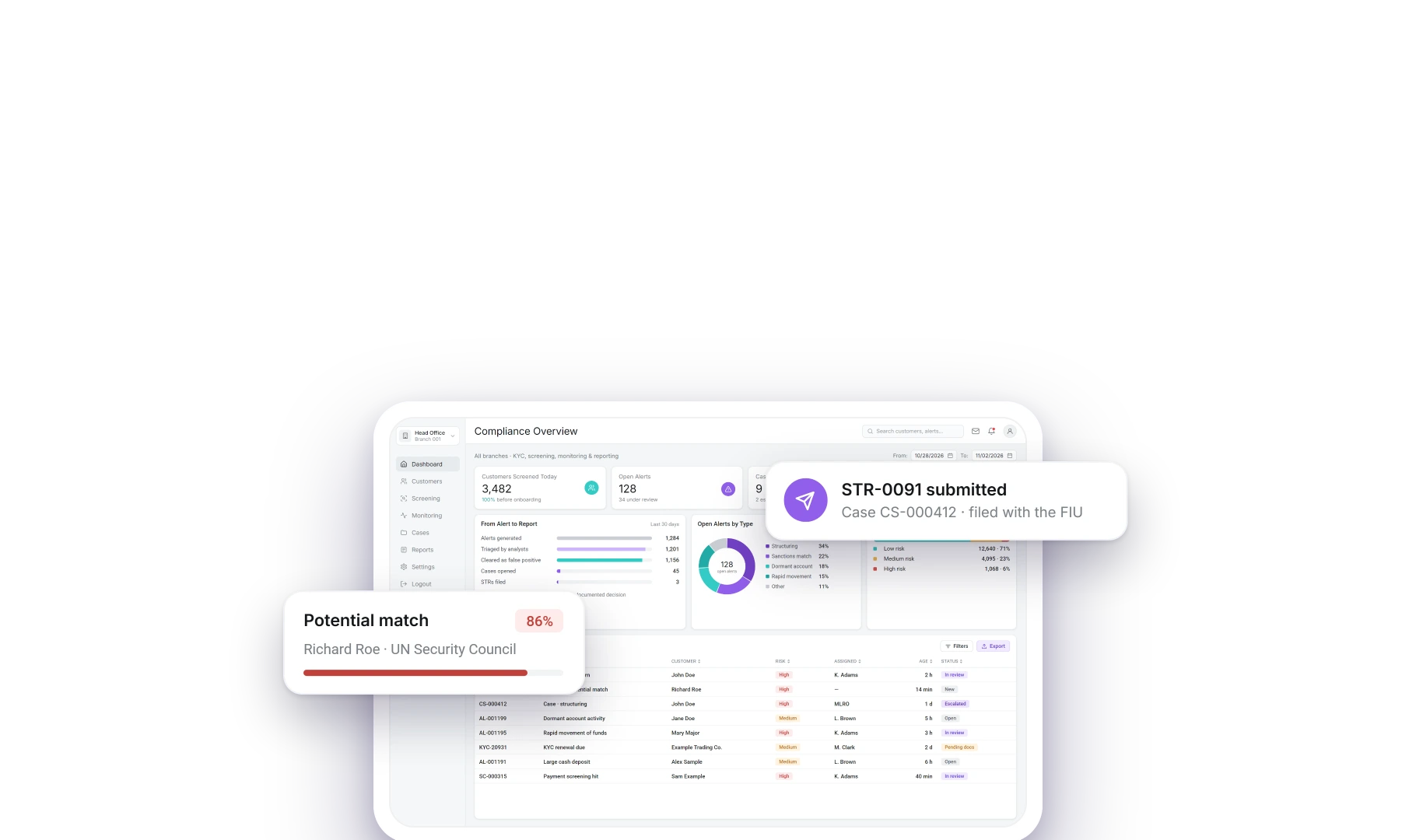
Data Gear connects KYC, sanctions screening, transaction monitoring and regulatory reporting in one platform, so nothing falls between the stages.


Data Gear connects KYC,sanctions screening, transaction monitoring and regulatory reporting in oneplatform, so nothing falls between the stages.A walkthrough tailored to yourcompliance team. No commitment.
90–95% of AML alerts are commonly estimated to be falsepositives Industry estimates, e.g. Youverify, Sayari (2026)

When most alerts are dead ends, the speed and consistency of triage decide how much time analysts spend on real risk. A connected case workflow gives them the context they need and leaves a clear record of every decision.
When each stage runs in a different tool, risk hides between the stages, not inside them.

Every stage lives in its own system, so information gets lost at each handoff.

An alert alone isn’t enough. Without a case, an investigation and a documented decision, the trail disappears.

When an examiner or a correspondent bank asks, it’s hard to prove what was actually done.
Data Gear connects each stage to the one before and after it, and every action is documented and reviewable. Screens shown are illustrative

Collect and analyze customer information, and identify the ultimate beneficial owner (UBO).

Rate each customer low, medium or high and apply the right level of due diligence.

Screen names and payments before execution, with analyst review of every potential match.

Monitoring scenarios and rules generate alerts for suspicious patterns.

Documents, customer activity and the full investigation trail in one place.

Prepare suspicious transaction (STR) and cash transaction (CTR) reports in the required format.
A clear, documented path means nothing depends on one person’s memory.
The system continuously scans activity based on risk parameters.
A potential risk triggers a flag in the system.
An analyst reviews each potential match. A false positive lets the transaction proceed; a true match is stopped, frozen, and escalated.
The full file comes together. Documents, customer activity, and the investigation trail stay in one place, from the first alert to the final decision.
The final report is filed, creating a permanent, compliant record of the investigation.
The risks that sit around money laundering shouldn’t need separate tools.
Screen customer names and payments against local and international sanctions lists, including UN Security Council lists. Payments are checked before execution, and every potential match goes to an analyst.
Spot red flags in import and export transactions: over- or under-invoicing, the same shipment financed more than once, phantom shipments, mismatched goods, and listed parties, vessels or ports.
Cover internal and external fraud, from unauthorized changes and dormant-account withdrawals to account takeover and phishing, with a risk assessment before each transaction runs: allow, verify or decline.
Compliance has become a national priority. Banks that prepare early avoid last-minute pressure.
A workshop on the national strategy for combating money laundering, terrorist financing and proliferation financing was launched in Damascus with the UN Development Programme.
Source: SANA, Al Jazeera (July 2026)
Official statements indicate Syria is preparing for a rigorous international evaluation in 2027, where the effectiveness of controls in practice is what counts.
Source: Erem Business
Quick answers before you request a demo.
A walkthrough of the full compliance cycle, from KYC to reporting, and answers to your team’s specific questions.
Yes. It includes modules for trade-based money laundering (TBML) and anti-fraud alongside the core compliance cycle.
Yes. The platform supports preparing suspicious transaction and cash transaction reports in the required electronic format.
A risk-based approach focuses effort where risk is highest, and we’ll discuss what fits the size of your institution.
Depends on institution size and the modules in scope.
A walkthrough of the full cycle, from KYC to reporting. Answers to your institution’s specific questions. No commitment.


