Discover
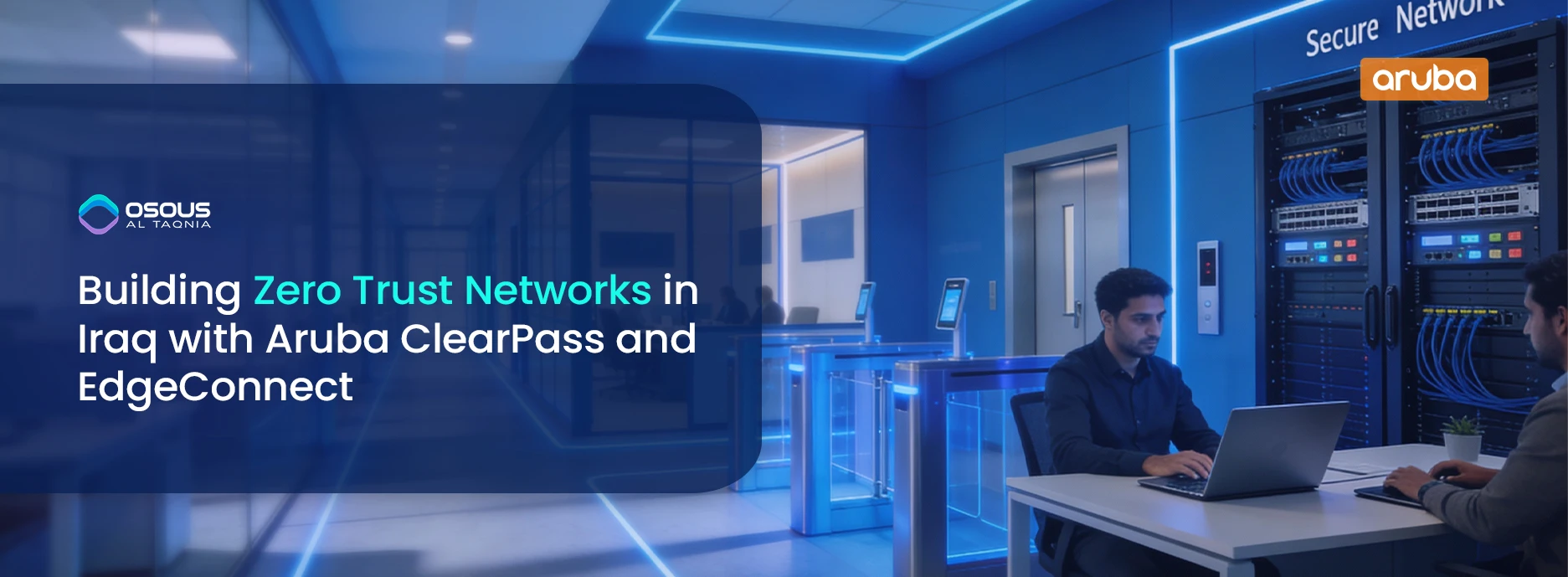
As organizations in Iraq expand their digital operations, traditional network security models are no longer enough. Users work from offices, branches, and remote locations. Devices range from laptops and phones to printers and IoT systems. In this environment, trusting anything simply because it is inside the network creates real risk.
At Osous Al Taqnia, we help organizations move toward a zero trust network model using Aruba ClearPass and EdgeConnect. This approach verifies every user, device, and connection before granting access, no matter where it comes from.
In this article, we explain how zero trust works in practice, share a real client scenario from Iraq, and show how Aruba solutions make zero trust achievable without overcomplicating the network.
Many organizations in Iraq still rely on perimeter-based security. Once a user connects to the internal network, access is often broad and loosely controlled. This creates several risks:
Zero trust addresses these issues by removing implicit trust and enforcing verification at every step.
Our client was a services organization with a headquarters in Baghdad and multiple branch offices in Basra and other cities. They supported office staff, field teams, and third-party contractors.
The organization faced:
They needed stronger control without disrupting daily operations.
As an Aruba Partner in Iraq, we designed a zero trust framework based on three principles:
To achieve this, we combined Aruba ClearPass for access control and Aruba EdgeConnect for secure connectivity.
We deployed Aruba ClearPass to authenticate:
Access decisions were based on user identity, device type, and compliance status.
ClearPass allowed us to segment the network dynamically, separating:
This ensured that users only accessed what they were authorized to use.
To extend zero trust beyond the office, we implemented Aruba EdgeConnect SD-WAN.
This provided:
Every connection was authenticated and protected, regardless of location.
EdgeConnect allowed us to apply policies based on application type, ensuring that:
This reduced risk while improving performance.
By integrating ClearPass and EdgeConnect, the IT team gained:
Security became proactive rather than reactive.
After deploying the zero trust architecture, the organization achieved:
The network became more secure without becoming harder to manage.
Aruba solutions work well for zero trust deployments in Iraq because they:
This makes zero trust achievable even with limited IT resources.
Zero trust is not a product. It is a strategy that must fit how your organization actually works.
At Osous Al Taqnia, we provide:
We help organizations improve security without disrupting productivity.
If your organization in Iraq is planning to strengthen its network security or adopt a zero-trust approach:
Book a consultation with Osous Al Taqnia to learn how Aruba ClearPass and EdgeConnect can support your goals.

6th Floor, The Meydan Hotel, Nad Al Sheba, Dubai
Villa S 11/5, Atconz, Erbil
62nd St, Baghdad