Discover
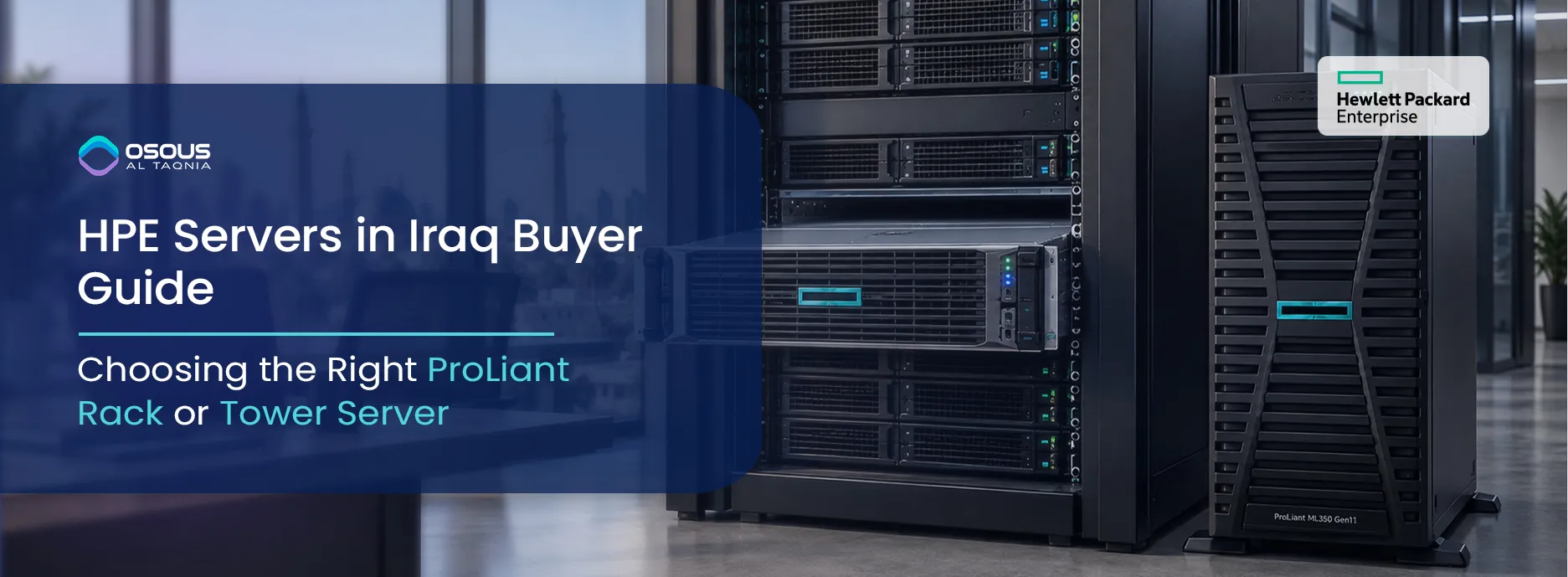
If you manage IT infrastructure in Iraq, server performance, reliability, and support are essential to keeping business systems available. From ERP and databases to virtualization and critical applications, choosing the right server directly affects day-to-day operations.
HPE ProLiant servers provide scalable compute solutions for small businesses, enterprises, government organizations, and data centers. With the right local IT partner, businesses can select the right configuration and receive professional installation and ongoing support across Baghdad, Erbil, Basra, and other locations in Iraq.
This guide covers the main HPE server options, workloads, sizing considerations, deployment services, and factors that influence HPE server pricing in Iraq.
HPE ProLiant servers are available in different form factors designed for specific environments and workloads:
The right choice depends on your applications, number of users, virtualization requirements, available infrastructure, and expected future growth.
HPE ProLiant DL rack servers are designed for organizations that need scalable computing within structured server rooms and data centers.
They are commonly used for:
Their rack-mounted design makes it easier to consolidate multiple servers while maintaining organized power, networking, cooling, and management.
HPE offers different ProLiant DL configurations depending on performance and workload requirements.
For organizations consolidating older infrastructure or expanding a data center, ProLiant DL servers provide a flexible platform that can scale with growing compute requirements.
HPE ProLiant ML tower servers are a practical choice for small and medium-sized businesses that need dedicated server infrastructure without installing a complete rack environment.
Tower servers are commonly deployed for:
Their expandable design also allows businesses to increase memory and storage as their requirements grow.
For businesses without a dedicated data center, an HPE tower server can provide enterprise server capabilities in a more office-friendly format.
A complete infrastructure solution involves more than compute. HPE ProLiant servers can be combined with enterprise storage and networking technologies to build a scalable IT environment.
Depending on requirements, organizations can integrate servers with HPE MSA or other HPE storage platforms for shared storage, backup, databases, and virtualization environments.
HPE servers can also be integrated with HPE Aruba Networking solutions to provide reliable connectivity between servers, users, storage, and other infrastructure components.
Planning compute, storage, networking, backup, and security together helps prevent infrastructure bottlenecks as workloads grow.
When selecting HPE servers in Iraq, businesses should look beyond basic CPU and memory specifications. Reliability, scalability, remote management, security, and lifecycle management are equally important.
HPE ProLiant servers support modern processor platforms, expandable memory, and flexible HDD, SSD, and NVMe storage options depending on the selected model.
This makes them suitable for workloads such as:
Rather than simply choosing the most powerful server available, CPU, RAM, storage, and networking should be sized according to actual workload requirements and expected growth.
HPE Integrated Lights-Out (iLO) provides remote server management capabilities that help IT administrators monitor and manage ProLiant infrastructure.
Administrators can remotely monitor server health, troubleshoot issues, manage firmware, and perform administrative tasks without always needing physical access to the server.
For Iraqi organizations operating infrastructure across multiple offices or cities, remote management can significantly simplify IT operations and reduce unnecessary site visits.
HPE management technologies such as HPE OneView can further support infrastructure monitoring, inventory, alerting, and lifecycle management.
HPE ProLiant servers include hardware and firmware security technologies designed to protect the server throughout its lifecycle.
Depending on the generation and configuration, capabilities can include:
RAID and redundant components are particularly important for critical ERP, database, and virtualization environments where hardware failures should not result in unnecessary service interruptions.
When planning to buy HPE servers in Iraq, organizations should work with qualified IT infrastructure providers that can supply genuine hardware and provide proper technical support.
The supplier should understand both the HPE product portfolio and the customer’s actual infrastructure requirements.
Working with an experienced HPE supplier can provide several advantages:
For mission-critical environments, procurement should be considered part of the overall infrastructure project rather than simply purchasing hardware.
Organizations with offices or facilities across Iraq should also consider the supplier’s local support capabilities.
A capable infrastructure provider can offer:
For businesses operating across Baghdad, Erbil, Basra, and other Iraqi cities, nationwide support can simplify infrastructure management and reduce downtime.
Choosing the best HPE server starts with understanding what the server actually needs to run.
Before selecting a model, consider:
These requirements can then be translated into the appropriate ProLiant model and configuration.
Server sizing should be based on actual workloads rather than choosing specifications based only on budget.
CPU: File services may require relatively modest processing power, while virtualization, databases, ERP, and analytics may require significantly more cores.
RAM: Virtualization and databases often require large memory capacity. Allowing room for future expansion can prevent premature server replacement.
Storage: HDDs remain useful for capacity-focused workloads, SSDs provide stronger general application performance, and NVMe storage is suitable for workloads requiring high IOPS and low latency.
A proper assessment of existing CPU, RAM, and storage utilization can provide a useful starting point when designing a replacement server.
Critical systems should not depend entirely on a single server.
Depending on the organization’s requirements, an HPE server infrastructure can include:
Organizations with multiple offices or data centers in Iraq can also replicate critical workloads between locations to improve business continuity.
Purchasing the right hardware is only the first step. Proper deployment ensures that the server delivers the expected performance, reliability, and security.
A professional HPE server deployment can include:
HPE servers can support different infrastructure environments.
Small offices: Tower or entry-level rack servers can support accounting, file sharing, identity services, and other business applications.
Branch offices: Compact servers can provide local services while remaining centrally monitored by the organization’s IT team.
Data centers: Multiple ProLiant rack servers can support virtualization clusters, databases, ERP systems, private cloud environments, and other enterprise workloads.
The architecture should be designed according to business requirements rather than applying the same server configuration to every environment.
Organizations can also use managed services to keep their server infrastructure healthy after deployment.
Typical services include:
Proactive maintenance can identify potential problems before they develop into major service interruptions.
There is no single HPE server price in Iraq because the final cost depends heavily on configuration.
Two HPE ProLiant servers using the same base model can have very different prices depending on their processors, memory, storage, controllers, networking, redundancy, and warranty options.
The main factors include:
For this reason, comparing only the base server model does not provide an accurate picture of the total project cost.
To receive an accurate HPE server quotation in Iraq, provide your IT supplier with information about:
Based on these requirements, the infrastructure team can recommend an appropriate HPE ProLiant server and configuration instead of oversizing or undersizing the system.
Yes. HPE ProLiant servers can be sourced for businesses and organizations in Iraq through IT infrastructure suppliers and approved supply channels. Availability and delivery time depend on the server model, configuration, and whether the required hardware is available locally or needs to be ordered.
Small businesses can typically start with an HPE ProLiant ML tower server or an entry-level DL rack server. The best option depends on the applications, number of users, storage requirements, virtualization plans, available rack infrastructure, and expected business growth.
HPE ProLiant DL servers are rack-mounted systems designed primarily for structured server rooms and data centers. HPE ProLiant ML servers use a tower form factor and are commonly selected for offices, SMBs, and branch locations where a dedicated rack environment may not be available.
Yes. Properly configured HPE ProLiant servers can support virtualization, private cloud, ERP, databases, VDI, and other enterprise workloads. CPU, memory, storage, networking, and redundancy should be sized according to the number and type of workloads being hosted.
Delivery time depends on the required configuration and local availability. Standard configurations may be available faster, while customized or high-performance servers may require additional procurement time. Installation and configuration can also be included as part of the server deployment project.
Yes, qualified infrastructure providers can offer server assessment, installation, configuration, migration, remote support, preventive maintenance, and on-site troubleshooting. Organizations with critical workloads can also choose SLA-based support services based on their required response times.
Whether you need a server for a small office, virtualization cluster, ERP platform, or complete data center, selecting the right HPE ProLiant configuration is essential for long-term performance and reliability.
Speak with our infrastructure specialists to assess your workloads, select the right HPE rack or tower server, and receive a tailored quotation with professional deployment and ongoing support across Baghdad, Erbil, Basra, and other locations in Iraq.

6th Floor, The Meydan Hotel, Nad Al Sheba, Dubai
Villa S 11/5, Atconz, Erbil
62nd St, Baghdad