Discover
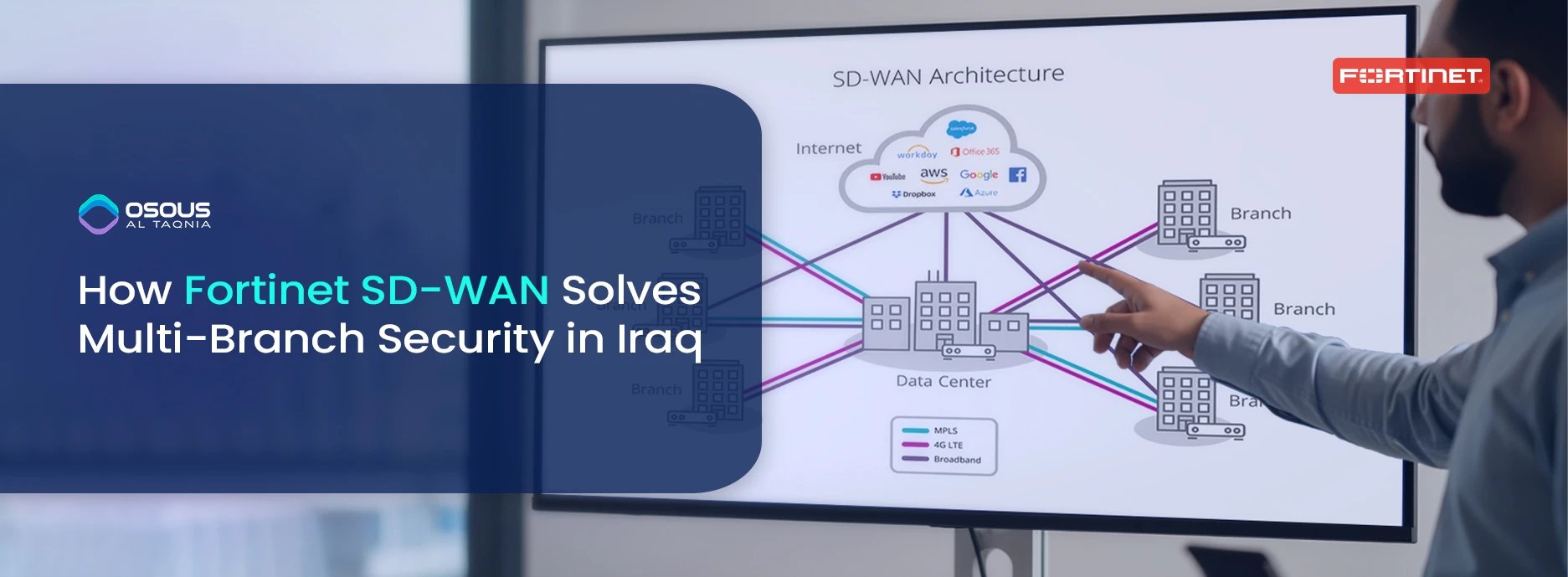
Managing secure connectivity between multiple branches in Iraq is not simple. Many organizations operate offices in Baghdad, Basra, Erbil, and other cities, often relying on unstable links, mismatched security policies, and legacy WAN setups that were never designed for today’s traffic volumes.
At Osous Al Taqnia, we regularly help Iraqi organizations move from traditional WAN architectures to Fortinet SD-WAN, combining performance, security, and centralized control in one solution. This article explains a real client scenario in Iraq, the challenges they faced, how we implemented Fortinet SD-WAN, and the results they achieved.
If your business relies on multiple branches, this will help you understand whether SD-WAN is the right step forward.
Many Iraqi businesses grow organically. New branches are added quickly, often using whatever connectivity is available at the time. Over the years, this has led to:
Security is often bolted on later, which increases risk and management overhead.
Our client was a private Iraqi group operating more than 20 branches across Baghdad, Basra, Najaf, and Erbil. Their business depended heavily on centralized systems hosted at headquarters.
They were facing several issues:
The IT team needed a solution that could improve performance without sacrificing security.
As a Fortinet Partner in Iraq, our recommendation was based on three priorities:
Fortinet SD-WAN met all three requirements.
Unlike traditional SD-WAN solutions, Fortinet SD-WAN is built directly into FortiGate firewalls. This allowed us to:
In simple terms, each branch had one device handling both security and routing.
We configured application-aware routing to:
For branches in Basra and Najaf, this significantly reduced downtime caused by unstable links.
To speed up rollout, we used zero-touch provisioning. Branch devices were shipped preconfigured, allowing local staff to connect them without advanced IT knowledge.
Once online, all policies were pushed centrally by our team at Osous Al Taqnia.
With Fortinet SD-WAN, the client gained:
This reduced response time during incidents and gave management clear insights into network usage.
Within weeks of deployment, the client reported:
Most importantly, the IT team could now scale the network confidently as the business expanded.
Fortinet SD-WAN works particularly well in Iraq because it:
For organizations operating across Iraq, this flexibility is essential.
Deploying SD-WAN successfully depends on local experience, not just technology.
At Osous Al Taqnia, we provide:
We make sure your SD-WAN deployment delivers real value, not just new hardware.
If your organization is struggling with multi-branch connectivity or planning to modernize its WAN:
Talk to our experts today, request a quote, or book a consultation with Osous Al Taqnia to learn how Fortinet SD-WAN can support your operations in Iraq.

6th Floor, The Meydan Hotel, Nad Al Sheba, Dubai
Villa S 11/5, Atconz, Erbil
62nd St, Baghdad