Discover
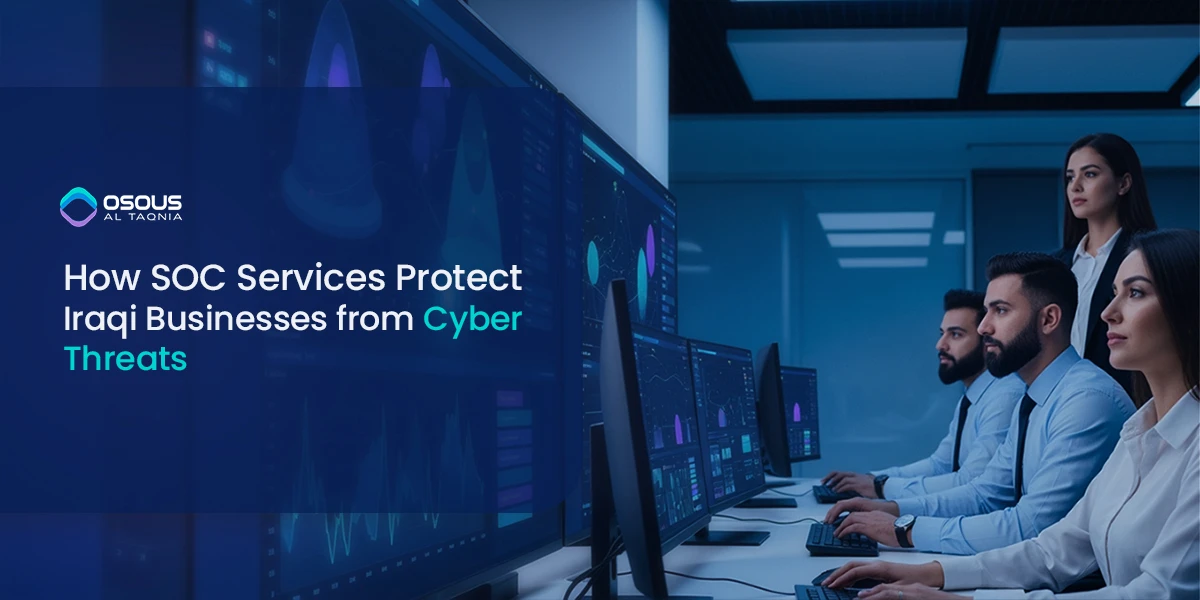
Cyberattacks targeting Iraqi businesses have grown more frequent, more complex, and more damaging than ever before. Attackers no longer rely solely on simple phishing emails or basic malware. Instead, they use coordinated intrusions, credential theft, zero-day vulnerabilities, and targeted ransomware campaigns against banks, oil and gas companies, logistics firms, telecommunications providers, and public-sector organizations.
In this environment, traditional security tools such as antivirus software or firewalls are insufficient. Organizations need continuous, real-time monitoring and expert response. That is exactly what a Security Operations Center (SOC) provides.
In this article, Osous Al Taqnia explains how SOC services work, why they are essential in Iraq’s business landscape, and how they help companies detect and stop cyber threats before they cause serious damage.
A Security Operations Center is a centralized team of cybersecurity professionals who:
A SOC is the “command center” of cybersecurity. It combines people, processes, and technology to protect the organization in real time.
Iraq’s cybersecurity landscape presents several challenges:
Attackers frequently target financial institutions, oil companies, and government agencies.
More organizations are adopting cloud services, remote work, and mobile access, which increases attack surfaces.
Most businesses in Iraq do not have dedicated security teams that can monitor systems around the clock.
A mix of legacy servers, hybrid cloud, and modern applications makes security management difficult.
New data protection regulations require organizations to maintain strong security controls and incident response procedures.
A SOC provides the continuous oversight required to keep up with these challenges.
A mid-sized engineering firm in Baghdad began experiencing unusual activity on several employee computers.
The internal IT team initially thought it was a software bug. However, Osous Al Taqnia’s SOC detected a known ransomware behavior pattern.
Our analysts immediately:
Without SOC monitoring, the ransomware would have spread rapidly and caused severe downtime.
Cyberattacks often occur outside normal business hours. A SOC monitors:
This ensures no suspicious activity goes unnoticed.
Using SIEM (Security Information and Event Management) and advanced analytics, the SOC identifies:
These alerts allow the team to respond instantly.
When an attack is detected, time is everything.
SOC teams:
This reduces downtime and prevents further damage.
A SOC uses global and regional intelligence to stay ahead of attackers.
This includes:
By understanding current threats, the SOC can stop them early.
Iraqi businesses increasingly face compliance requirements, especially in:
SOC services generate detailed reports that help prove compliance and identify long-term improvements.
SOC analysts provide continuous recommendations:
Security becomes a long-term, strategic process rather than a reaction.
Attacks are stopped before they escalate.
Early detection prevents costly breaches.
Fast responses avoid data exposure and reputational damage.
Systems stay available even during attempted attacks.
Secure environments allow organizations to adopt new technologies safely.
Osous Al Taqnia provides SOC services specifically built for Iraq’s cybersecurity challenges.
Our team understands the attack patterns, business environments, and infrastructure realities in Iraq.
We monitor cloud, on-premise, and hybrid environments continuously.
We work with:
We act immediately when suspicious activity appears.
Our reports are simple, actionable, and built for real-world decision-making.
If your business does not have continuous visibility into its systems, it is at risk. A single incident can lead to downtime, financial loss, or data exposure.
Let Osous Al Taqnia protect your organization with proactive, 24/7 SOC monitoring. Book a consultation with our cybersecurity team
Your peace of mind starts with visibility.

6th Floor, The Meydan Hotel, Nad Al Sheba, Dubai
Villa S 11/5, Atconz, Erbil
62nd St, Baghdad