Discover
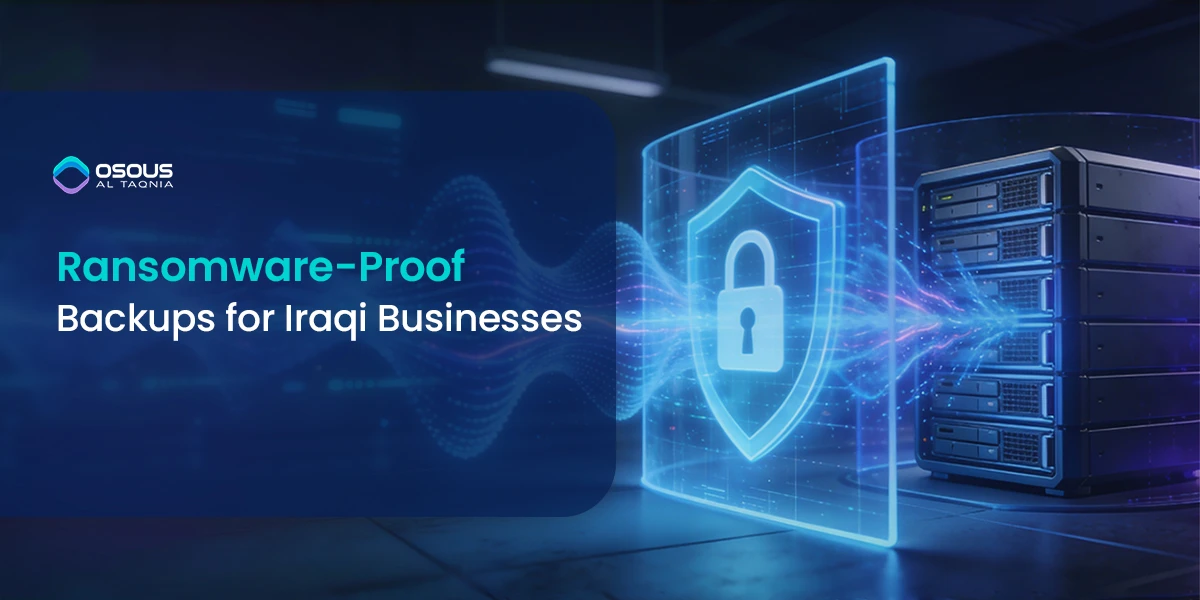
Ransomware attacks in Iraq continue to rise, with businesses in Baghdad, Basra, Erbil, and Mosul increasingly targeted by cybercriminals aiming to encrypt critical data and demand payment. While many organizations invest in firewalls, antivirus, and email security, one weakness remains common: backups that are not protected against ransomware.
Once attackers break into a system, they often go straight for backup files. If they can delete or encrypt the backup repository, the business is left with no recovery option, forcing them to pay the ransom or face catastrophic data loss.
The good news is that ransomware-proof backups are completely achievable when designed correctly. In this article, Osous Al Taqnia explains what ransomware-proof backups are, how attackers target backup systems, and what Iraqi businesses can do to ensure their data is always recoverable.
Many Iraqi businesses still rely on basic backup methods such as:
These methods fail because modern ransomware:
Once backup data is destroyed, even the best cybersecurity tools cannot undo the damage.
A mid-sized engineering company in Basra reached out to Osous Al Taqnia after being hit by ransomware.
Storing backups on connected storage without isolation or immutability makes them easy targets.
A ransomware-proof backup ensures that even if attackers compromise your network, the backup cannot be altered, deleted, or encrypted.
This requires a combination of technologies and processes:
Immutable backups cannot be modified for a defined period. This makes them impossible for ransomware to encrypt.
Solutions like Veeam Hardened Repository, Object Lock (S3), and Azure immutable storage are commonly implemented.
An air-gapped backup is physically or logically separated from the network. Types include:
Even if attackers compromise the network, the air-gapped copy remains untouched.
Backup consoles and cloud dashboards must be protected with:
This prevents attackers from using stolen credentials to delete backups.
Even if attackers obtain storage access, encrypted backups cannot be opened, altered, or misused.
Iraqi companies handling sensitive data, especially financial, governmental, and healthcare entities, benefit immensely from this layer of protection.
Cloud repositories add resilience and separation from local infrastructure.
Azure Backup and Veeam Cloud Connect are the most common options for Iraq-based deployments.
Many backups fail long before a disaster is discovered. Iraqi SMEs often encounter:
Monitoring ensures every backup is verified and fully recoverable.
Our approach combines cybersecurity and data protection into one cohesive system.
We evaluate:
We customize:
We implement:
We perform:
Our team provides:
This layered strategy ensures backups remain intact no matter what happens.
These solutions benefit every industry:
Protecting financial systems and customer data is mandatory.
Operational data, contracts, and technical documents must remain safe.
Shipment data and delivery schedules cannot be lost.
Patient data loss can be catastrophic.
Schools and universities need resilience during digital transformation.
Critical national records require tamper-proof protection.
Even small businesses benefit from ransomware-proof strategies, since downtime and data loss can be far more expensive than the investment in proper backups.
If your backup system can be deleted, encrypted, or accessed by attackers, your business is vulnerable. Now is the time to strengthen your protection. Talk to our cybersecurity team about fully integrated DR and backup strategies
Osous Al Taqnia is ready to help your business stay resilient against modern cyber threats.

6th Floor, The Meydan Hotel, Nad Al Sheba, Dubai
Villa S 11/5, Atconz, Erbil
62nd St, Baghdad