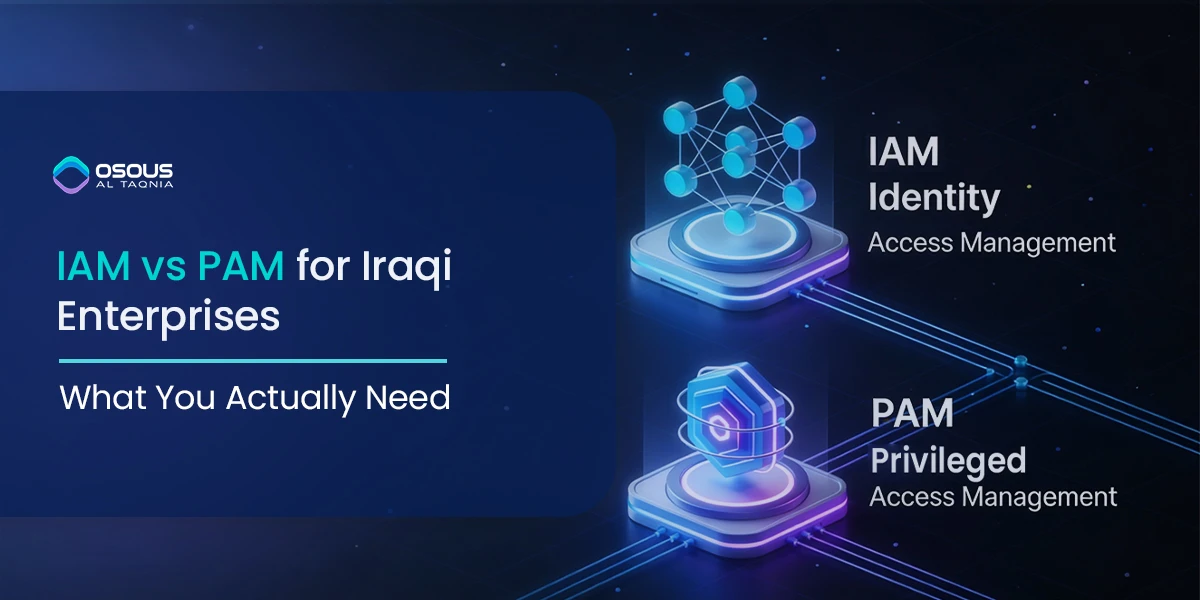
IAM vs PAM for Iraqi Enterprises: What Your Business Actually Needs
By:
Rami
Updated on:
December 23, 2025
As Iraqi businesses become more digital, the need to control who accesses systems is more important than ever. Cyberattacks in Iraq increasingly target user accounts, administrator credentials, and privileged access to financial systems, cloud services, and internal networks. This makes Identity and Access Management (IAM) and Privileged Access Management (PAM) critical pillars of modern cybersecurity.
But many companies ask the same question: Do we need IAM, PAM, or both? This article breaks down the difference, shows a real case from Iraq, and explains how Osous Al Taqnia helps organizations choose the right access control strategy.
Administrator privileges are given to too many users
Insecure VPN or remote access
Weak cloud identity configurations
Password-only access to financial or operational systems
These issues create major risks for banks, oil & gas companies, logistics firms, schools, healthcare providers, and the public sector. Attackers know that weak identity controls are the easiest way to breach an organization.
Privileged Account Misuse at a Manufacturing Firm in Baghdad
A manufacturing company in Baghdad contacted Osous Al Taqnia after experiencing suspicious system changes. Their ERP system showed unauthorized modifications in procurement and inventory records.
The Problem
Several IT staff shared the same administrator account
No logs indicated who performed specific actions
Privileged access was granted permanently, not temporarily
The ERP system had no MFA for admin login
External contractors occasionally accessed systems with no monitoring
This led to inaccurate reporting, financial inconsistencies, and internal disputes.
What We Did
Osous Al Taqnia deployed a combined IAM + PAM strategy:
Implemented IAM for all employees using Azure AD and conditional access
Forced MFA on all system logins, especially admin roles
Created unique accounts for all IT users
Deployed PAM to control privileged sessions and record admin activity
Enabled session monitoring for contractors and remote users
Outcome
Full visibility into all administrative actions
No more shared accounts
Strong protection against internal misuse and external breaches
Faster audits and easier investigations
Better compliance with internal governance policies
This case shows why IAM and PAM must work together for high-risk environments.
IAM and PAM Explained in Simple Terms
What Is IAM (Identity and Access Management)?
IAM ensures that the right people have access to the right systems at the right time.
IAM controls:
User identities (who you are)
Authentication (how you sign in)
Authorization (what you can access)
Passwordless login and MFA
Access lifecycle management
Single Sign-On (SSO)
IAM answers the question: “Should this user be allowed to access this system?”
IAM is essential for every organization that uses cloud services, Microsoft 365, internal applications, or remote work.
What Is PAM (Privileged Access Management)?
PAM protects administrators and high-privilege accounts that can make major changes in your systems.
PAM controls:
Domain admin accounts
Server and database administrators
Network and firewall administrators
ERP and financial system superusers
Cloud admin roles (Azure, M365)
Temporary elevated permissions
Session recording and auditing
PAM answers the question: “Should this person have powerful admin privileges, and for how long?”
PAM is critical for organizations with sensitive data, high-risk operations, or compliance requirements.
Key Differences Between IAM and PAM
Feature
IAM
PAM
Manages everyday user accounts
✔️
—
Manages admin and privileged accounts
—
✔️
MFA enforcement
✔️
✔️
Controls access to cloud and internal apps
✔️
✔️
Session monitoring and recording
—
✔️
Temporary elevated access
—
✔️
Reduces risk of insider threats
✔️
✔️✔️ (stronger)
Supports zero-trust security
✔️
✔️
In simple terms:
IAM protects your general workforce
PAM protects your most powerful accounts
Most cybersecurity incidents in Iraq involve account misuse, which makes both essential for modern environments.
When Iraqi Companies Need IAM, PAM, or Both
You need IAM if:
Your staff access cloud systems (Microsoft 365, Azure, ERP, CRM)
You want MFA and conditional access
You need SSO for multiple applications
Employees often join, leave, or move between roles
You want centralized identity management
IAM is foundational for all organizations.
You need PAM if:
You have IT administrators or superuser accounts
You manage servers, databases, or domain controllers
You run financial systems with elevated permissions
You hire contractors or external IT teams
You want accountability and session recording
You want to eliminate shared admin passwords
PAM is essential for banks, energy companies, telecom, logistics, and manufacturing.
You need IAM + PAM together if:
You want full visibility and control over all identities
Your infrastructure mixes on-prem and cloud
You have compliance requirements
You want zero-trust security
You have sensitive or regulated data
This combination is now the global standard, and Iraqi organizations are adopting it rapidly.
How IAM and PAM Strengthen Cybersecurity in Iraq
Implementing IAM and PAM helps prevent:
Account takeovers
Unauthorized system access
Insider misuse
Ransomware spread
Financial manipulation
Configuration tampering
Privilege escalation attacks
With MFA, conditional access, and privileged session monitoring, attackers lose their easiest entry points.
How Osous Al Taqnia Delivers IAM and PAM for Iraqi Businesses
Our team provides end-to-end implementation of identity security solutions tailored to Iraqi operations.
1. Identity Environment Assessment
We analyze:
User roles
Permission mapping
Admin accounts
VPN and remote access
Cloud identity configuration
2. IAM Deployment
Including:
MFA
Conditional access
SSO integration
Automated onboarding/offboarding
Passwordless authentication
3. PAM Deployment
Including:
Privileged account vaulting
Temporary access workflows
Session monitoring and recording
Command and action logging
Secure remote administration
Just-in-time access
4. Policy Development
We help establish:
Least-privilege rules
Access request workflows
Role-based access policies
Compliance documentation
5. Continuous Monitoring
Our SOC team monitors:
Abnormal login attempts
Privilege escalations
Policy violations
Access risk alerts
This ensures ongoing protection beyond the initial deployment.
Protect Your Identities Before an Incident Happens
If your organization still depends on shared accounts or password-based access, now is the time to act. Talk to our cybersecurity team about building a zero-trust identity strategy.
Osous Al Taqnia is ready to help your business secure every identity, every privilege, and every critical system.